By: Hannah Hesford | April 1, 2026
Have things been feeling like a bit much lately?
It’s something that comes up again and again — in chats with friends, with retreat guests, and in our own lives too. Researchers and economists have started calling it the “Great Exhaustion” — which, dramatic as it sounds, does feel oddly accurate some days.
There’s often a lot going on. Some of it close to home, some of it further away — and it’s not always easy to ignore the weight of it. Alongside that, there’s the day-to-day. The usual responsibilities, the things you’re holding together.
Together, it can feel like a heavy load. But if you’ve been feeling properly tired lately — not just physically, but in that deeper, harder-to-shake way — you’re really not alone. And it doesn’t have to stay this way.
A different kind of tired
There’s a particular kind of tired that comes with this. Not the kind that an early night fixes. Not even the kind that a quiet weekend really shifts.
It’s more like your head just feels full. Like there’s always something ticking over in the background. You might feel knackered even when you’ve slept, find it hard to focus, or notice that your usual motivation just isn’t quite there.
It can be subtle at first. Easy to brush off. You tell yourself you just need a good night’s sleep, or a quieter week. And then a quieter week comes and goes, and it’s still there. That low hum of carrying too much for too long. If you’re nodding along right now — that makes complete sense.
Why it can feel this way
Part of the challenge is that there’s no real boundary anymore. We’re more connected than ever, which means we’re more exposed than ever. It’s easy to fall into a rhythm of constantly checking, scrolling, absorbing — even when you don’t mean to.
Our brains are wired with a natural negativity bias — a built-in survival mechanism that scans for threats — which means we’re more likely to hold onto the difficult stuff than the good.
And none of that means anything is wrong with you. It’s a pretty human response to the world we’re living in right now. Most people are carrying some version of this — they’re just not always talking about it.
It tends to sit across two levels at once. There’s the macro — everything happening in the world around us. And then there’s the micro — your own life, your own responsibilities, your own mental load. Individually, both can be manageable. Together, they can create that constant sense of weight. Like your system never quite gets a proper break.
The good news? Even small shifts can change that feeling significantly.
What can help (even a little)
None of this is about fixing the world — we wish it were that simple. But there are things that genuinely help. Small shifts that make it feel a bit more manageable to move through.
Recognise it first
It helps to name what’s going on. A lot of people push through or assume they should be coping better. But if your head feels full, if you’re more tired than usual, if you can’t quite switch off — there’s usually a reason for that.
There’s growing evidence that this kind of “always on” state — where your nervous system is constantly processing information and low-level stress — leads to a form of fatigue that sleep alone doesn’t fix. Just naming that can take a bit of pressure off.
Ease the noise where you can
It helps to be more intentional about how much you’re taking in. That doesn’t mean ignoring the world or not caring — it means checking the news once or twice a day instead of constantly, turning off notifications, giving yourself proper breaks from screens.
Our brains aren’t designed to process a constant stream of global information. Small boundaries here can make a noticeable difference.
Come back to simple things
The things that help most aren’t complicated. Spending time outside. Moving your body in a way that feels good. Talking to people you trust. Doing things that aren’t tied to productivity.
For some people that might include heat and cold — a sauna, a cold plunge, even a cold shower — anything that helps your body shift out of that constant “on” state.
None of this is groundbreaking, we know. But these are usually the first things to quietly disappear when life gets full — and almost always the things that bring you back to yourself.
Give yourself proper space
Finally — and this one matters — give yourself space that isn’t just a few hours snatched between things. Space where you’re not being pulled in different directions. Where you’re not constantly reacting to what’s coming in. Where your attention can actually settle.
That looks different for everyone. For some people it’s small daily shifts. For others it means stepping a bit further away — creating real distance from both the bigger noise and the smaller demands.

What that space can do
It’s something that sits at the heart of everything we do at Reclaim Yourself. We’re drawn to wild, harder-to-get-to places precisely because they offer something you simply can’t manufacture in everyday life — a genuine shift in perspective, a sense of scale, a reminder that the world is still full of beauty and possibility.
We take care of everything. Every detail, every decision, every moment — thoughtfully designed so that for once, you don’t have to hold it all together. All you have to do is show up.
When you’re somewhere truly extraordinary — somewhere that asks something different of you — the usual noise struggles to follow. And in that space, something shifts.
You sleep differently. You breathe differently. The things that felt immovable start to feel a little lighter.
That’s not escapism. It’s restoration. A personalised pause from the world — one that sends you home feeling more rested, more steady, and more like yourself than you have in a long time. And that doesn’t just stay with you. It carries into your work, your relationships, and the way you show up in everything — and everyone — that matters to you.
None of this takes away from what’s happening in the world. But it changes how you move through it — with more space, more clarity, and more capacity than before.
We might just know the place
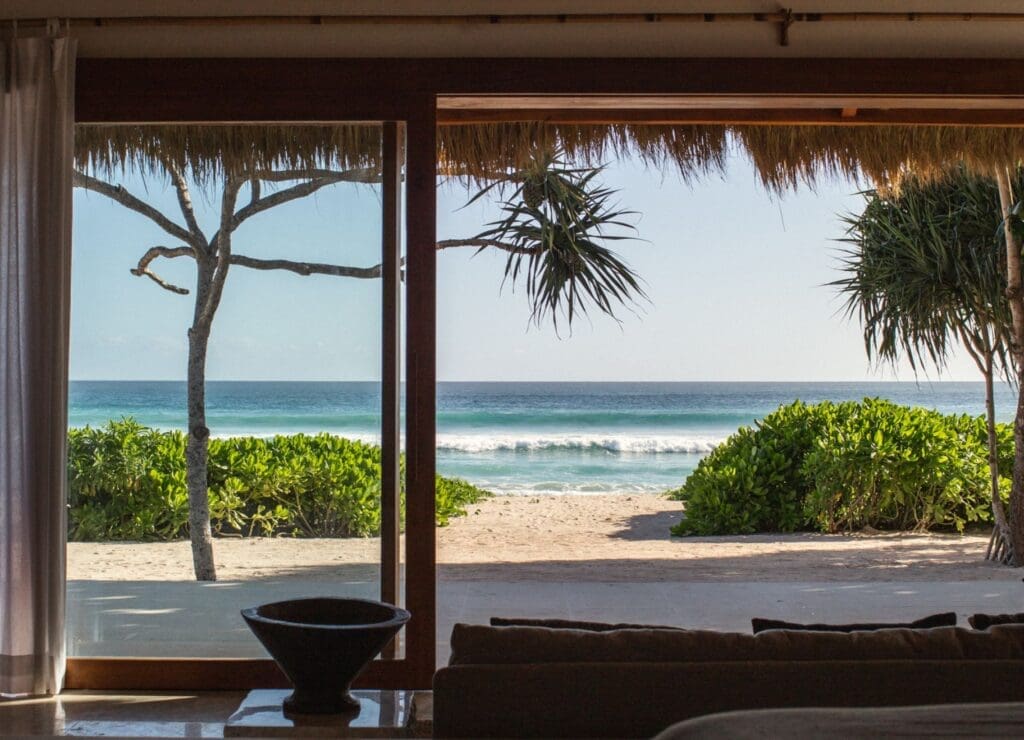
If any of this resonated, this might be for you. Join us on Sumba — one of Indonesia’s most unspoiled islands, where white sand beaches stretch for miles and the noise of everyday life struggles to follow.
Swim, surf, ride horses along the beach, explore — or simply do nothing at all. Which, if you’ve read this far, might be exactly what you need.