
By: Hannah Hesford | July 18, 2026
The wind hits you before anything else does. Oh no, this isn’t a gentle breeze or some random gust. But an actual physical force that makes you plant your feet a bit wider (and hold onto your hat if you’d quite like to see it again). Somewhere above, Mount Fitz Roy is doing its usual trick of hiding inside its own private weather system. And you wait, because everyone here waits. The mountain appears when it’s ready, not a second sooner.
Shared by Chile and Argentina, Patagonia is one of the last great wildernesses on Earth. Glaciers calve into turquoise lakes. Granite spires punch through the clouds like they were designed by Tolkien. The wind never quite eases. After a while, you stop expecting it to. You just, well…learn to lean into it. Literally.
We’d spent years imagining Patagonia. We’d pored over photographs, flicked through Bruce Chatwin’s In Patagonia, and watched enough documentaries to feel like we almost knew it already. But arriving still felt like a surprise.
You see it first from the air. Three hours or so south of Buenos Aires, a city we’ve completely fallen for lately (but that’s a story for another day), the plane drops low and suddenly you’re looking at something that could pass for the moon. Flat, dry and seemingly endless, the colour of toast, with rivers scribbled across it. This isn’t the Patagonia that ends up on postcards. The lakes, glaciers and jagged peaks everyone pictures when they hear “Patagonia” are really just a sliver of it, tucked along the Andes where Chile and Argentina meet.
It was also the moment we realised Patagonia isn’t somewhere you “do” in one short trip. It’s simply too bloomin’ big. You’re only ever scratching the surface, which makes choosing the right corners to explore all the more important. We knew we wanted to spend our time where Patagonia’s landscapes feel at their wildest.
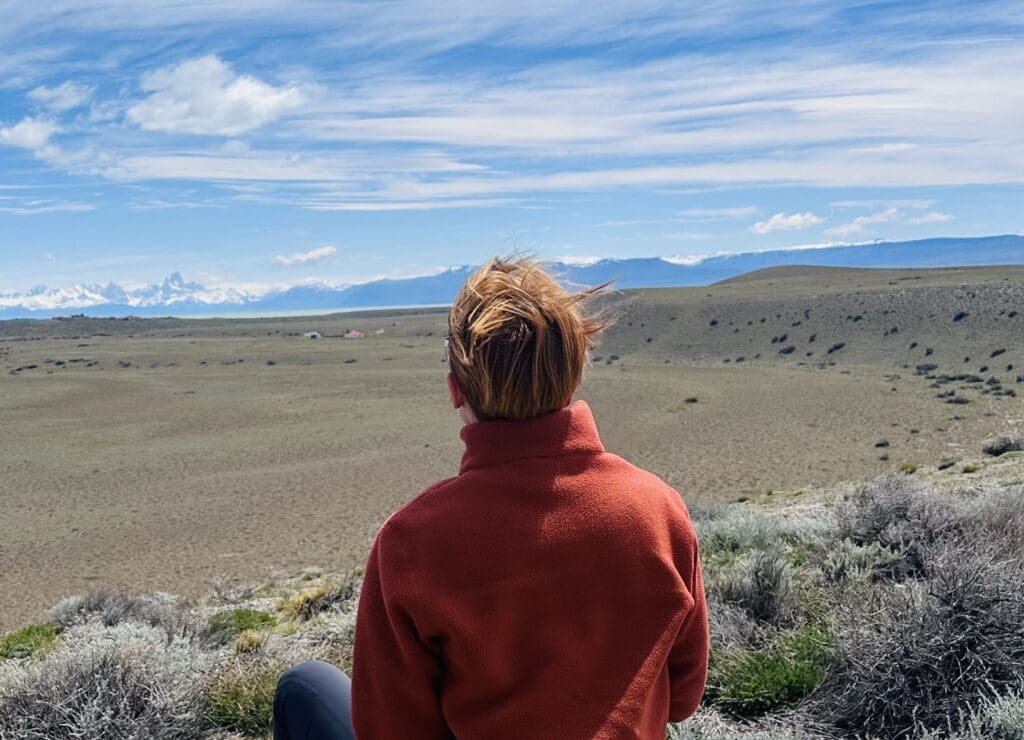
Much of Argentine Patagonia is this. Dry, wind-battered and almost absurdly empty, with the occasional small town scattered across the steppe. You can drive for hours without seeing much more than guanacos, sheep and the odd farmhouse. But somehow it makes the mountains hit harder when they finally emerge on the horizon.
Waiting for Fitz Roy
Okay, let’s start with El Chaltén, a tiny town that didn’t exist until 1985. Argentina built it almost overnight to stake a claim on the border with Chile. These days it’s the country’s trekking capital, with a permanent population still under two thousand, a mix of climbers who came for a season and stayed, and families who’ve worked this land far longer than the town itself has existed. You’ll see why the second you step off the bus. Fitz Roy rises sheer and jagged above the valley, so often wrapped in cloud that locals joke the mountain makes its own rules. Ask anyone who’s waited three days with a camera for the clouds to lift, they’ll tell you who wins that particular standoff.
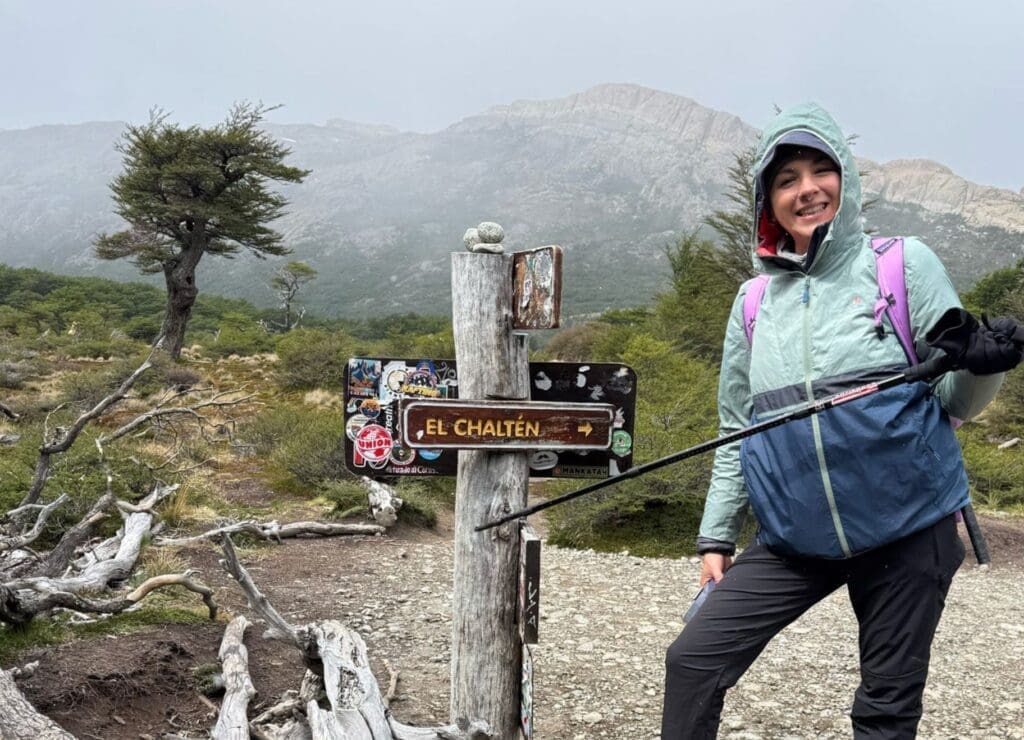
The peak has another name too. Locals call it Chaltén, meaning “smoking mountain” in the language of the Tehuelche people who lived here long before climbers and travellers arrived. The clouds gathering around its summit gave it the name. See it in person and you understand immediately.
Fitz Roy isn’t even the strangest story in the valley. That belongs to its neighbour, Cerro Torre, a slender granite spike so sheer and ice-crowned that for years nobody believed it could be climbed at all. In 1959, an Italian climber named Cesare Maestri claimed he’d done exactly that, with his partner Toni Egger dying in an avalanche on the way down, taking the only camera and any proof with him. Most of the climbing world doubts it ever happened. Nobody’s ever found a trace of their route, and the real first ascent is generally credited to a different team, fifteen years later, up the opposite side of the mountain. Maestri spent the rest of his life insisting he’d told the truth. Whether he did remains one of mountaineering’s greatest unsolved controversies.
When is the best time to visit Patagonia?
If there’s one thing we’ve learnt over the years, it’s that when you come matters almost as much as where you go. Patagonia changes dramatically with the seasons, and while there’s no single “best” time to visit, there is a best time depending on the experience you’re looking for.
We love November. The spring wildflowers are beginning to pop, there are less hikers on the trails, and there’s a lovely sense that the landscape is only just waking up after winter. Well, at least, that’s the theory. Patagonia has been known to throw in the odd reminder that winter isn’t quite finished with you yet. In fact, last November we saw both sides of it. One week we were hiking in bright blue skies wearing T-shirts. The next, we were pulling on every extra layer we’d packed as dramatic storms rolled across the mountains. Same month. Same trails. Completely different mood. Patagonia always has the final say.
It’s also one of the reasons we’ve chosen November and December year for our retreat. Not because it’s guaranteed sunshine (this is Patagonia, after all), but because it strikes a balance between quieter trails, changing landscapes and the kind of conditions that invite you to slow down and experience the place as it is, rather than trying to cram everything in.
The trail to Laguna de los Tres
Laguna de los Tres is the classic hike around here, and it’s a cracker – though it doesn’t ease you in gently. This is a full-on day on your feet, winding through beech forest so thick with moss and beard lichen that the trees actually look cosy. Fun fact: that wispy lichen only really thrives where the air is incredibly clean. City-dwellers, prepare your lungs for a beautiful shock to the system.
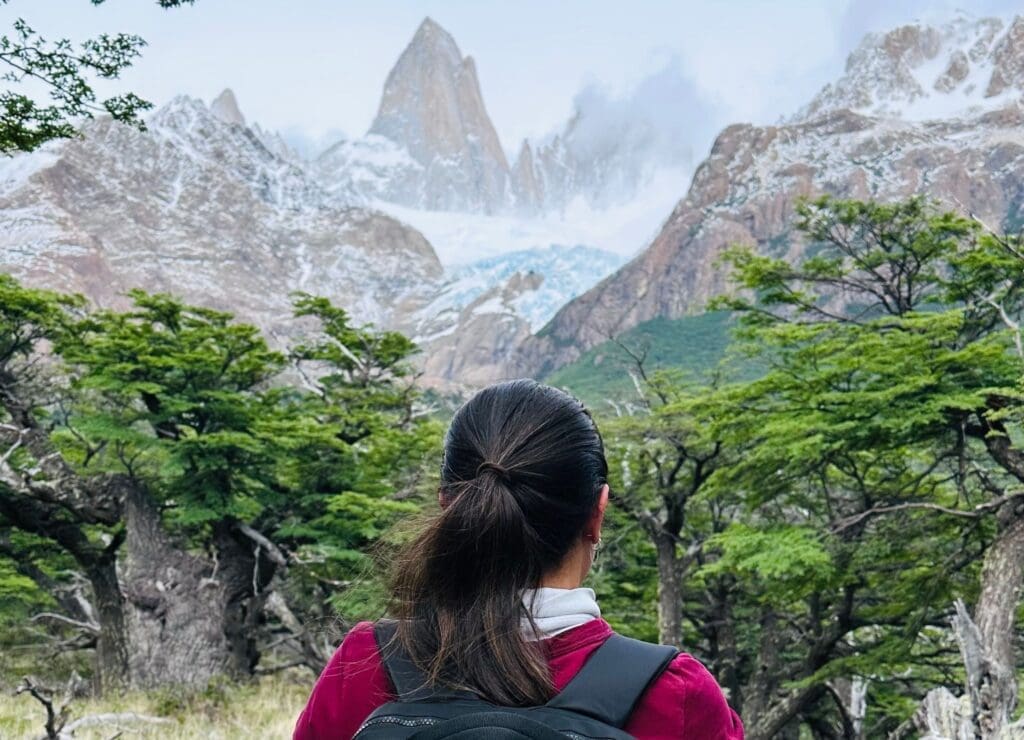
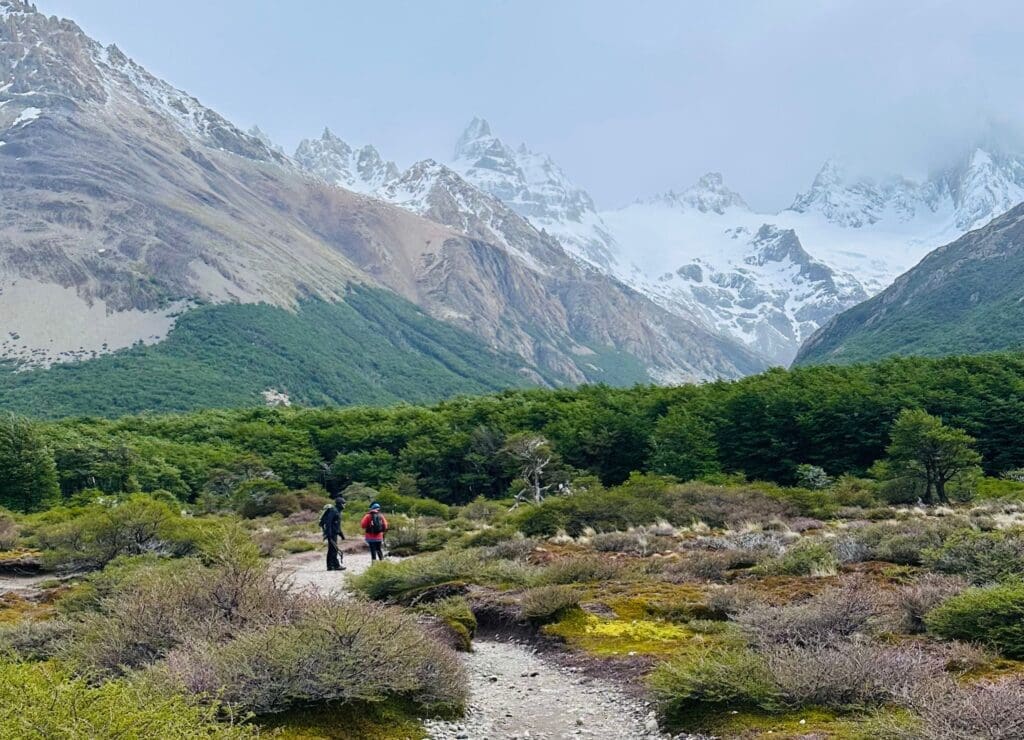
There are streams to cross, glimpses of Fitz Roy through the trees, and distant glaciers clinging to the mountainsides. The colours catch you off guard too. Against all that granite and snow, patches of lime green, golden moss and soft mauve shrubland seem to glow, making the whole landscape look ever so slightly unreal. Before long, you’ll be more than ready to perch on a shady boulder, unwrap the empanadas (of course!) packed into your picnic lunch and simply sit for a while, listening to glacial rivers by, and let the cool mountain air do the rest.
Then comes the final kilometre. The trees disappear, the path rears upwards and everything becomes rock, loose scree and increasingly creative swearing. It’s steep, exposed and just relentless enough to make you question several of your recent life choices. But then you crest the ridge and there it is: Laguna de los Tres, an almost implausibly blue glacial lake, with Fitz Roy rising directly behind it as though it has been waiting all morning for your arrival.
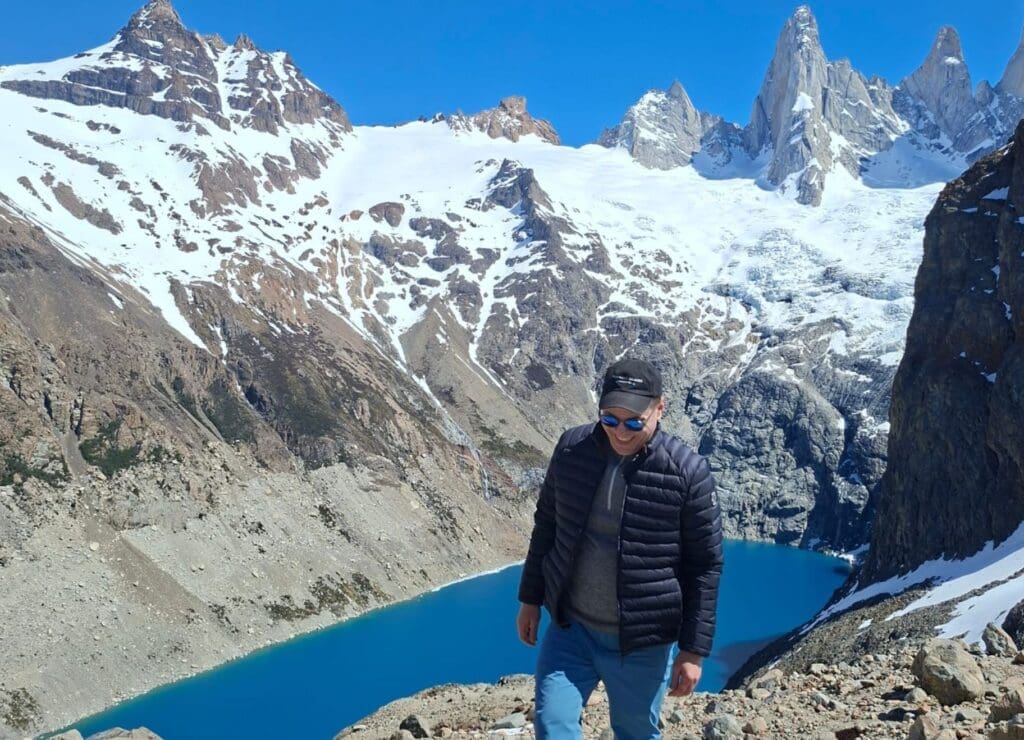
It’s one of the most photographed views in South America, but seeing it on a screen doesn’t prepare you for arriving under your own steam, cheeks stinging from the wind and legs still humming from the climb. It feels completely different when you’ve walked every step to get there. Then it’s time to eat whatever snacks you haven’t already demolished, take far too many photos and begin the slightly inconvenient business of walking all the way back again.
If you’re wondering what it’s actually like to hike here – from watching the weather forecasts all week to finally standing beneath Fitz Roy- we wrote more about our own experience hiking in Los Glaciares National Park.
The Patagonia state of mind
Back in El Chaltén, it doesn’t take long before your days start to look wonderfully simple. You wake up, look out of the window to see what Patagonia has in store, roll out your yoga mat, then pull on your boots and head outside. The weather calls the shots. Phone signal barely crosses your mind. Before you know it, life has shrunk to the essentials: hearty food, fresh air and a flask of something hot waiting for you afterwards. In the evening, you come back to your mat, carrying the day with you. There’s something rather special about that ping-pong between adventure and stillness.
Perhaps that’s Patagonia’s greatest lesson. You quickly realise you’re not the one in charge. The mountain decides whether it’ll show itself. The weather is very much the boss. Sometimes the best thing you can do is stop checking the forecast every five minutes and just get on with the day. It’s strangely liberating. We spend so much of our lives trying to control every little thing, and then you come somewhere like this and remember there’s another way.
Surrounded by vast swathes of protected national park, the Patagonia’s wilderness still feels properly wild. You’re not here to conquer it. You’re simply lucky enough to spend a little time in it.
Of course, Patagonia isn’t all about hiking. One morning you might swap your boots for a kayak and paddle across the impossibly clear waters of Lago del Desierto, with glaciers hanging in the distance and hardly another soul around. The only soundtrack is the splash of your paddle and the occasional reminder that you’ve drifted off course because you’ve been too busy staring at the scenery.
Patagonia’s wild residents
Keep looking up while you’re hiking because Patagonia has a habit of rewarding the curious. One minute you’re watching where you put your feet, the next there’s an Andean condor riding the thermals overhead. With wingspans stretching close to three metres, they’re among the largest flying birds on the planet. Despite their fearsome appearance, they’re not hunters at all – just giant vultures with excellent PR. (Trust us, if one glides overhead while you’re hiking, you’ll remember it. We spotted a pair on our way up to Laguna de los Tres in 2025, and for a minute everyone just stopped, looked up and watched them drift overhead. Pure joy.)
If you’re hoping to spot one, Mirador de los Cóndores is worth the short climb. Spend ten minutes there and there’s a good chance one will appear, circling lazily overhead like it knows everyone has come to admire it.
Down on the ground, guanacos are much less interested in putting on a show. You’ll spot them grazing across the steppe, staring vaguely in your direction before wandering off as if they have somewhere more important to be. They’re the wild ancestors of llamas and one of Patagonia’s most familiar sights.
And then there are the animals you’ll mostly have to imagine. Endangered huemul deer and elusive pumas still roam Patagonia’s wilder corners, but they’re absolute masters of staying out of sight. If you do happen to spot one, congratulations – and maybe pick up a lottery ticket while you’re at it.
Life Beyond the Mountains
Patagonia isn’t only mountains. Beyond the peaks, family-run estancias have shaped life on these plains for generations, with gauchos still herding sheep across the vast steppe much as they always have. Time moves a little differently here. Think open skies, home-cooked asado and a place with more guanacos than people, which, once you’re there, feels like a pretty good ratio.
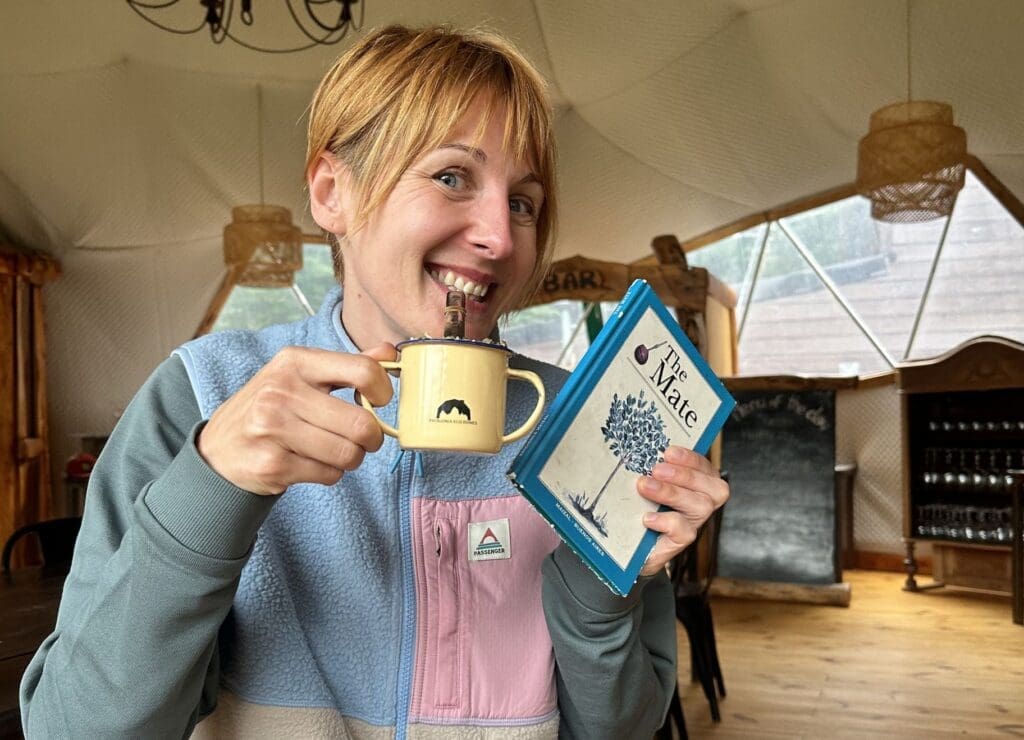
Gauchos are as much a part of Patagonia as the mountains themselves. Skilled horsemen, they’ve been herding sheep across this land for generations. You’ll likely be offered mate at some point, a strong herbal tea sipped through a metal straw from a shared gourd that’s passed around the group. There’s a bit of unspoken etiquette to it: drink your share, pass it on, and only say thank you when you don’t want any more. Say it too early and everyone will assume you’re done. It’s less a drink than a small ritual of hospitality, with rules nobody tells you until you’ve already broken one.
El Calafate: Patagonia’s glacier gateway
From El Chaltén, the road heads south to El Calafate, a small town on the shores of Lago Argentino and the gateway to the southern reaches of Los Glaciares National Park. If the name hasn’t already given the game away, this is glacier country. Big, blue, creaking glacier country.
Many travellers spend a few nights here before exploring the glaciers, and it’s also where you’ll find some of Patagonia’s traditional estancias. Originally built as sheep ranches, many have been lovingly converted into small family-run guesthouses, where roaring fires, hearty home-cooked meals and warm Patagonian hospitality make the perfect antidote to a day spent in the elements.
Among Patagonia’s glaciers
Los Glaciares National Park takes its name from the 47 glaciers that spill down from the Southern Patagonian Ice Field, one of the largest expanses of ice outside Antarctica and Greenland. While you’ve already glimpsed some of them around El Chaltén, seeing them from the water is a completely different experience.
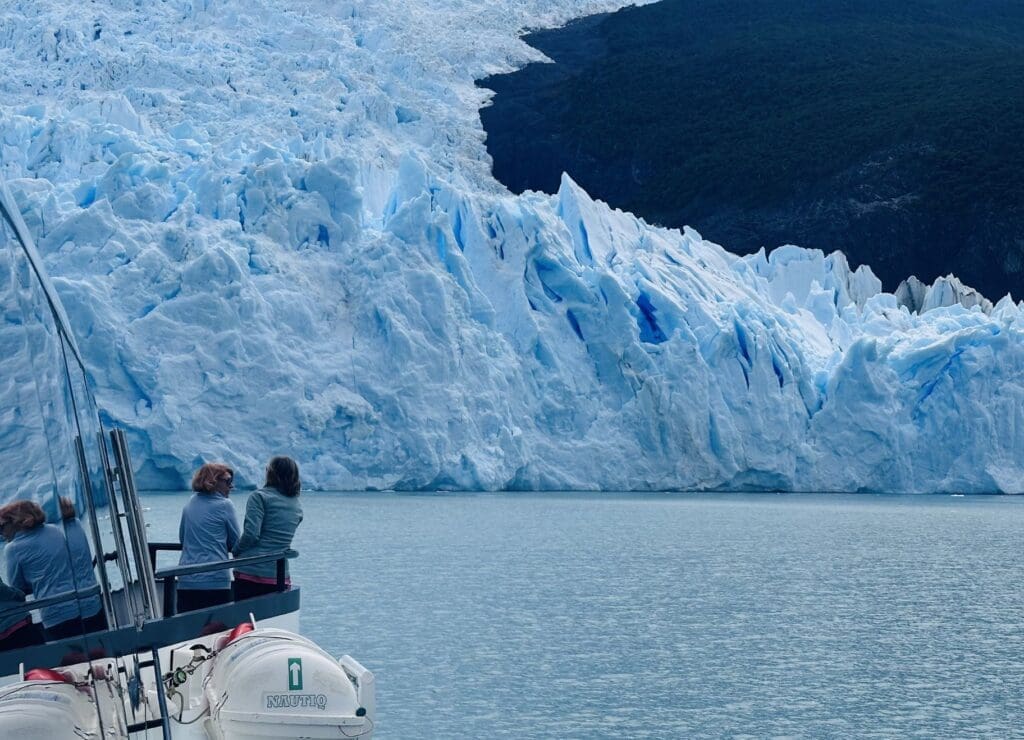
There are some places you can only really appreciate from a boat. Drifting between floating icebergs, with towering walls of ancient blue ice rising above you, gives you a completely different perspective on Patagonia’s scale. The photos prepare you for how they’ll look. They don’t prepare you for the sound. Every now and then, the silence is broken by a crack like distant thunder as another piece of ancient ice breaks away and crashes into the lake.
Boat trips across Lago Argentino pass several of the park’s spectacular glaciers, including Upsala and Spegazzini. They’re all completely different, and all ridiculously photogenic. Every few minutes you’ll convince yourself, “Just one more photo,” before immediately taking another five.

Perito Moreno: Worth the Hype?
If Patagonia has a showstopper, this is probably it. Even if you’ve seen glaciers before (a first for us!), nothing prepares you for their scale and power. This is a wall of ice five kilometres wide and 170 metres thick, and somehow the numbers still don’t quite prepare you either.
You hear them before you realise what you’re actually hearing. This low crack, like something enormous shifting in its sleep. Everyone stops talking, convinced this is the moment. Sometimes it is. Sometimes it isn’t. Then, without much more warning, a chunk the size of a double-decker bus just goes, straight into the lagoon, this wall of impossible blue, and the whole valley gets the sound a second later. It’s a proper show. We stood there for ages. I mean, how do you tear yourself away from that?
For decades, Perito Moreno was famous for doing what almost no other glacier on Earth could: holding its ground while others retreated. Today, scientists say that may be changing. Like glaciers across the world, it’s now losing mass and beginning to retreat, making the chance to stand in front of it feel all the more precious.
Let the Wind Decide
t’s kind of hard to explain Patagonia without feeling like you’re over-egging it. The mountains really are that dramatic. The glaciers really do sound like thunder. The wind really can blow you sideways.
And yet, that’s not really what stays with you.
Patagonia brings your senses back online. It’s the smell of the forest after rain, the colour of the moss against the granite, the sound of a river long before it comes into view.
There isn’t much point trying to rush Patagonia. The wind will blow when it wants to. The clouds will clear when they’re ready. If they don’t, well, there’ll still be another walk, another view, another fire to come back to. For a few days, Patagonia gets the final say. The place sets the pace, and there’s something surprisingly freeing about not having to be in charge all the time.
It’s hard not to feel a little awestruck here. A little humbled too. By the end of the week, the mountains are still enormous. Life somehow feels a little less so.
It takes a bold traveller just to come here. Joining a yoga retreat while you’re at it? That’s just showing off. See what our Patagonia adventures actually look like.